
Note from Larissa
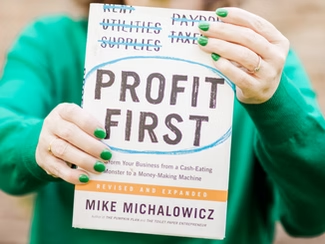
I was challenged to write an article about the book Profit First from the perspective of a gig worker. As many of you may know, I have been a gig worker for some time now and have my fair share of gripes with the industry. However, Profit First’s unique system is certainly applicable to gig workers and, if implemented correctly, could set many workers free from common gig economy problems. Let’s just say I will certainly be looking to consult with a Profit First Professional to understand this innovative system.
Profit First is an innovative system that reframes accounting to work with human behavior, borrowing ideas from previous generations. The author, Mike Michalowicz, describes his mother sorting money into a series of envelopes to understand her financial reality at a glance. Michalowicz instructs business owners to create a series of bank accounts that act similarly to those envelopes, which is where Profit First earns its name. Instead of thinking that profit happens after expenses, Michalowicz has business owners allocate a percentage of their revenue as profit. This brilliant strategy forces business owners to determine which expenses are necessary instead of spending money frivolously. The results are tremendous, and thousands of businesses have switched to Profit First because it works. Applying this to gig work, I identified three core tenets that are particularly relevant:
- Small Plate Theory – We need to ensure that we do not have access to 100% of the revenue we earn. If we have money, we’re going to spend it, and simply putting it out of sight enables us to be frugal and creative.
- Mastery Before Variety – While it’s tempting to offer exciting new services to clients for a quick payday, those new services come with their own set of expenses. We need to ensure that all our offered services are actually profitable.
- Cut Costs, Brutally – The bread and butter of Profit First is understanding what is truly needed for operations. Any unnecessary expenses take away from profit, and that isn’t acceptable.
Knowing these tenets didn’t automatically give me a roadmap for gig work. As a freelancer typing articles in Google Docs, I don’t always consider certain tools as business expenses. Moreover, gig workers operate on multiple platforms like Upwork, Fiverr, Gigworker.com, and Jobble, which all take a percentage of revenue. Upwork’s 10% service charge, for example, already takes a significant chunk of profit, which violates the core principles of Profit First.
How can gig workers cut costs to be more profitable? Two strategies come to mind: outgrowing the platform, and building service charges into rates. While critics may argue that these platforms are the only way to find work or that competitive rates are necessary, Michalowicz emphasizes that we need to be fair to ourselves first. Gig workers are not traditional employees; their value and rates should reflect the urgency and expertise clients require.
To further protect profits, gig workers can build direct client relationships outside the platforms. As reputation grows, clients are more likely to reach out directly for additional work, avoiding platform fees.
With these insights, I strongly recommend working with a Profit First Professional. No system is one-size-fits-all, and a professional can help customize the system for your specific business needs. While an article cannot fully capture the depth of this system, understanding its intuitive nature and core tenets can greatly benefit gig workers.